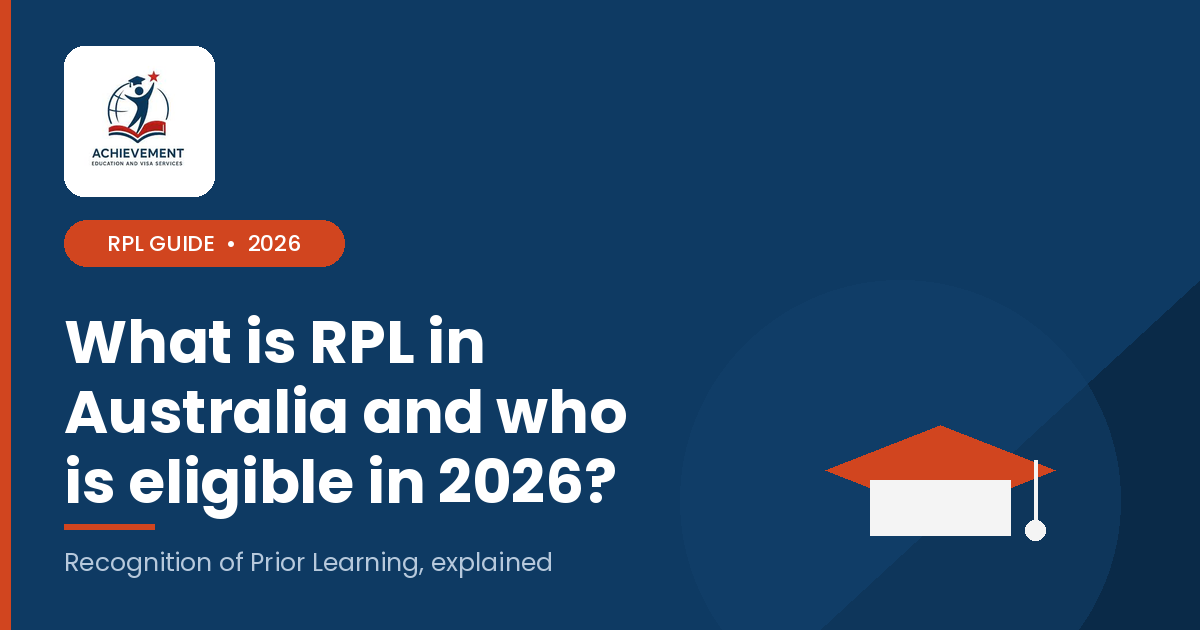
RPL is a process used to gain recognition of prior learning, qualifications, skills and knowledge gained from other training or work-based programs, and to achieve a nationally recognized qualifications in Australia through this process. This process remains a popular choice for workers, tradespeople, International students and overseas workers who have current work experience but may not hold formal qualifications in Australia.
RPL recognises what you already know and can do, rather than working from the start. Completed course requirements may be waived if the skills for a qualification are met.
This guide is designed to help you understand what training RPL is and how it functions, and who can apply for it and what's involved for RPL in Australia 2026.
What Is Recognition of Prior Learning (RPL)?
Recognition of Prior Learning (RPL) is a tracing back approach used by Australian Registered Training Organisations (RTOs), to assess a person's skills and experience already gained based upon the qualifications they wish to undertake.
RPL recognises learning gained through:
- Paid employment
- Owners of small business, trade or consulting firms or owners of small legal practices.
- Apprenticeships and traineeships
- Volunteer work
- Informal training
- Overseas work experience
- Short course industry certifications
For example, a chef with several years experience in a restaurant may be able to apply for a Certificate IV level of competency in Commercial Cookery via RPL rather than the full study. RPL is a component to Australia's National Vocational Education and Training (VET) system, and awards may lead to national recognition.
How Does RPL Work in Australia?
Recognition of Prior Learning (RPL) is a simple process to determine your acquired skills and knowledge, as a result of working experience, training or life. The process can vary depending on Registered Training Organisations (RTOs), but most RTOs follow a similar process. Some examples of RPL in Australia.
Step 1: is about selecting the wrong qualification.
You need to choose a qualification that is suitable for your abilities and career experience. There are many qualifications that can be obtained using RPL, such as:
- Business and Management
- Set Menu: Cookery and Hospitality à la Carte.Set Menu: Cookery and Hospitality à la Carte.
- Carpentry and Construction
- Automotive
- Information Technology
- Aged Care and Disability Support
- Community Services
- Leadership and Management
These are the reasons why it is important to select the right qualification as your evidence will be judged against the particular units that comprise the qualification.
Step 2: Submit Your Evidence
Presenting documents as proof of your skills, knowledge and work experience is required. This may include:
- Resume or CV
- Employment references
- Job descriptions
- Payslips
- Photos or video of your projects
- Assessment in which work samples or portfolios are utilized.
- Training certificates
- Overseas qualifications
- Licences or registrations
The higher the quality of evidence, the easier it is likely to be to assess.
Step 3: Skills Assessment
The evidence is assessed by a qualified assessor who then compares it to the competency requirements of the qualification. The assessor can additionally:
- Conduct an interview
- Ask additional questions
- Request more evidence
- If necessary, plan a demonstration.
You are expected to demonstrate your ability to achieve the literacy and numeracy skills requirements and tasks involved in the qualification.
Step 4: Receive Your Outcome
Once assessment will be completed, you will be awarded one of the following:
- Achieved on the completion of RPL for full qualification.
- Partial recognition for an some units.
- Recommendation: Train is needed for any other units.
When you pass all the requirements, you will be awarded a nationally recognised qualification from an Australian RTO.

Who Is Eligible for RPL in Australia in 2026?
RPL is available to people who have learnt skills and knowledge through their work, training, volunteering and/or life experiences. Candidates are not necessarily required to have formal qualifications for their applications. You may be eligible for RPL if you can provide evidence of experience and be able to meet the criteria for the qualification.
To qualify you must be:
- An Australian citizen or permanent resident who have work experience.
- An International student who has some experience in an industry field.
- An overseas worker who has acquired skills not acquired in Australia.
- A tradeperson looking for an official certificate for prior knowledge and experience.
- One of the business owners / self-employed persons.
- A worker that has already obtained cross-trainable skills and is transitioning to another career path.
- A person that has finished informally or received employer-based training but not acquired a formal qualification.
Most of the time, the applicants are required to have practical experience in the concerned qualification for which they are applying. Experience may be required for certain qualifications, but may also be required by the evidence for different qualifications.

What Evidence Do You Need for an RPL Application?
Part of the process of preparing for RPL is to gather in paperwork which demonstrates your ability and experience. These documents support assessors to make sure that they can see exactly what you have learnt and make a decision on whether you are eligible for a nationally recognised qualification.
|
Type of Evidence |
Examples |
|
Employment Documents |
Reference letters, contracts, payslips |
|
Work Samples |
Reports, projects, designs, menus, photos |
|
Qualifications |
Certificates, diplomas, overseas qualifications |
|
Training Records |
Short courses, workshops, licences |
|
Resume or CV |
Detailed work history and responsibilities |
|
Third-Party Reports |
Statements from supervisors or employers |
|
Practical Evidence |
Videos, portfolios, or demonstrations of work |
Not all kinds of evidence are required. Typically, there is a type of help that is provided by the assessors so as to help identify the most pertinent documents that are relevant to your qualification.
What Are the Benefits of RPL?
RPL may have a number of benefits if you have the skills and experience required for a qualification. It recognises prior learning which allows the achievement of a nationally recognised qualification without the need to repeat what has already been learned.
- Faster qualification: Your qualification may be earlier as you may be assessed for your current skills in the course as opposed to doing the subject in full.
- Access to enhanced job opportunities: Learners may like/be required by their employer to have a nationally recognised qualification, or access to enhanced employment opportunities.
- Career progress: A recognised qualification may help you progress to a different occupation, promotion or leadership roles.
- Recognition of overseas experience: RPL can aid to have your skills formally recognised in Australia if you have acquired work experience internationally.
- Pathway to further study: An RPL qualification is another option for helping to satisfy the entry requirements of a higher education qualification or further training.
Can International Students and Overseas Workers Apply for RPL?
Yes. If you demonstrate skills and experience on the job that meets the requirements for RPL in Australia then you may be eligible for International Students or Overseas Worker to apply.
For example:
- A person who has been a Chef in Nepal, India or another Overseas Location, might apply for a cookery Qualification in Australia.
- You can apply for an Australian IT qualification if you're an IT professional who has an overseas employment history.
- If they have years of practical experience, a construction worker might want to recognise it by means of RPL.
Experience gained overseas may also be accepted as evidence, if this work experience is verifiable with reference to work experience documents, references/other supporting documents. International graduates can also use RPL to enhance the skills on their resume which could improve their chances of finding work in Australia as an internationally recognised qualification.
RPL vs Credit Transfer: What's the Difference?
There are two options available for providing credit for prior learning: RPL and Credit Transfer. Understanding the difference can help you to decide which one is the right one for you based on your learning, skills and experiences.
|
Feature |
RPL |
Credit Transfer |
|
Based on |
Work experience and skills |
Previous formal study |
|
Evidence needed |
Work documents, portfolio, references |
Academic transcripts and certificates |
|
Assessment required |
Yes |
Usually minimal |
|
Recognises informal learning |
Yes |
No |
|
Recognises completed units |
Not necessarily |
Yes |
In layman's terms, RPL recognizes prior learning from experience – and Credit Transfer recognizes prior learning in formal education.
Conclusion
If you have the skills and experience but don't yet hold a formal qualification, Recognition of Prior Learning (RPL) is a great opportunity to consider. You might be able to achieve a nationally recognised award in a shorter timescale, enhance your employment prospects and save time undertaking your studies. If you have gained work experience in Australia or overseas, RPL could recognise your experience as a qualification recognised across Australia.
Here at Achievement Education, we are able to help you navigate the RPL process, help you decide which qualifications would be best for you to undertake and help you prepare your application. If you're studying, working or completing further training in Australia as part of your RPL or migration pathway, having the right health insurance cover in place is also an important step to stay compliant with your visa conditions. Our team also includes MARA Registered Migration Agents who can provide trusted migration advice where it relates to your education and career pathway. As the Best Student Visa & Migration Consultant in Sydney, we are committed to helping students and skilled professionals achieve their education and migration goals. If you're ready to have your skills recognised, contact us today and let us help you take the next step towards achieving your education and career goals.
Recommended blogs:
- Best Australian Courses for International Students Seeking PR
-
Australia Student Visa Rejection Reasons in 2026 and How to Avoid Them
Frequently Asked Questions
1. How long does the RPL process take?
This timeframe is liable to change based upon the qualification, the training provider and how fast you generate evidence. The time required for many instances of RPL usually takes a few weeks to a few months.
2. Is RPL recognised across Australia?
Yes. Education delivered under RPL from a Registered Training Organisation (RTO) is nationally recognised all over Australia.
3. Do I need work experience to apply for RPL?
In most cases, yes. RPL is designed to evaluate competency acquired in the workplace, during training or other learning experiences. The more relevant your experience is, the better your application will be.
4. Can overseas work experience be used for RPL?
Yes. Experience gained abroad can sometimes be accepted where relevant to the qualification and where this can be documented, for example, with reference letters, with employment records, or through an employment portfolio.
5. What happens if I don't meet all the requirements?
If you are missing competency for one or more of the units you may achieve partial competency and require further training and/or assessment for the remaining competency. This enables you to improve upon your current abilities instead of learning them over the course.