As a 491 visa holder working and residing in regional Australia, you might be thinking about what to do next and when you can step towards a permanent visa. If you meet certain conditions, the 191 visa can be a way to transition from your temporary regional visa to a permanent visa. This process is not as simple as it sounds. You need to manage your ATO Notices of Assessment, regional residence and visa conditions.
This guide breaks the pathway into simple steps and explains what you will need in 2026. It addresses the three-year 491 criteria, the three corresponding ATO Notices of Assessment, area of residence and compliance conditions, and the current position on income conditions for the 191 visa.
All you need to know should be clearly visible in the pathway, including what you are required to do, what documents you might need, and when you might be able to apply.
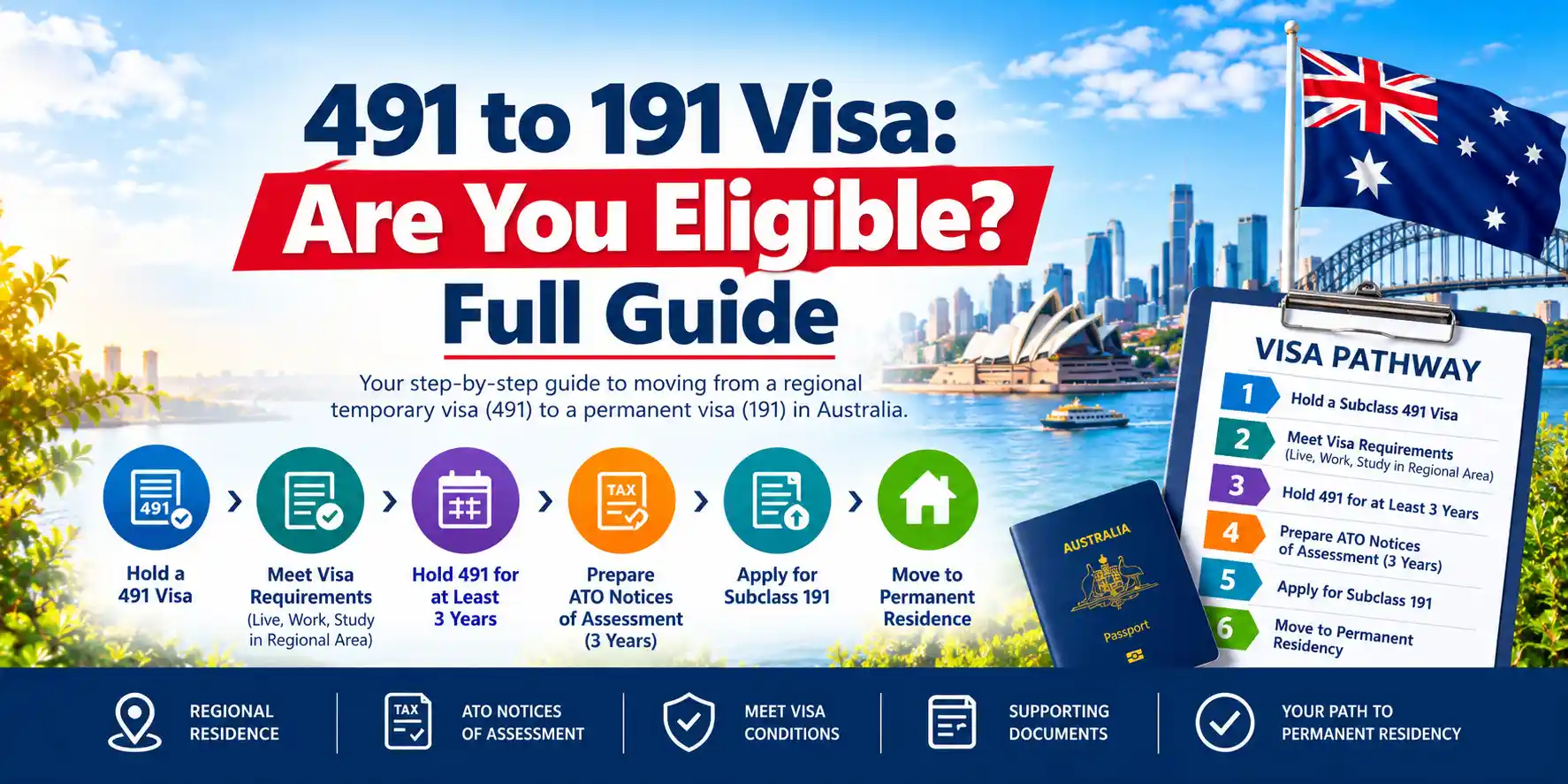
491 to 191 Visa Pathway
The subclass 491 Skilled Work Regional visa is a temporary visa that allows eligible skilled workers to live and work in designated regional areas of Australia. It can also provide a pathway to permanent residency through a subclass 191 visa if the visa holder meets the required conditions. The necessary conditions are that you must have held the 491 for at least three years, met its conditions, and have your tax records ready.
The process can be divided into the following steps:
- Hold a Subclass 491 Visa: The first step is to have an eligible visa 491.
- Satisfy visa requirements: Ensure that visa requirements are being adhered to (including what applies to living, working and studying in a designated regional area).
- Hold the 491 visa for at least 3 years: Comply with the 491 for a minimum of 3 years prior to 191 visa application.
- Prepare Your Tax Records: Have ATO Notices of Assessment ready for three income years.
- Apply for the Subclass 191: If you are eligible, apply for the Subclass 191: Regional Provisional stream.
- Move to Permanent Residence: If your 191 application is approved, you become a permanent resident of Australia.
The subclass 491 visa is for eligible visa holders who wish to live, work and study in a designated regional area of Australia for 5 years. The Department of Home Affairs states that after three years on the 491, you may be eligible to apply for permanent residency through the 191 if you meet its criteria.
You should continue to abide by the conditions of the visa during the three-year period. This includes meeting the requirements that apply to living, working and studying in a designated regional area. Additionally, in the case of the 191 Regional Provisional stream, you will need to have substantially met the visa conditions for the stream.
The 191 visa can be obtained after 3 years and meeting the other criteria.You must also provide Notices of Assessment for three income years. So it is important to maintain your tax records and other supporting papers during your 491 period, rather than waiting until you are ready to apply.
What Is the 491 Visa?
Skilled Work Regional (Provisional) visa (subclass 491) is a temporary visa for skilled workers who are nominated by an Australian state or territory government agency or sponsored by an eligible relative. It allows eligible visa holders to live, work and study in a designated regional area of Australia. The 491 is a points-tested visa; you need to meet the set points as well as other visa criteria when you apply for this visa. Once issued, the visa is valid for 5 years and offers a route to attaining permanent residency via subclass 191.
Remember, the regional requirement is important because what you do while on the 491 may affect your 191 application. Please refer to your letter of visa grant and check your visa conditions in VEVO and retain evidence of where you live and work.
What Is the 191 Visa?
Subclass 191 Permanent Residence (Skilled Regional) visa provides a pathway to permanent residency for eligible Subclass 491 visa holders who meet the required conditions. For the Regional Provisional stream, this means those who have held a Subclass 491 visa or Subclass 494 visa and met the relevant criteria.
The Subclass 191 is a permanent visa, unlike the temporary Subclass 491. If you are applying through the 491 to 191 pathway, you do not need to complete a new points test or obtain a new state or territory nomination. Rather, it is essential to show that you fulfilled the conditions of your regional provisional visa and then supply proof at the time of application.
Once your 191 is granted, you no longer need to comply with the regional restrictions of your 491. You can generally live, work, and study anywhere in Australia as a permanent resident.
491 to 191 Visa Eligibility Requirements

To apply for the Subclass 191, you need to meet certain requirements during your time on the Subclass 491. These include meeting the three-year requirement, income requirement and other visa conditions. You must also demonstrate that you have complied with the conditions of your 491 and have all tax and other records. The most important requirements for the Regional Provisional stream are:
- Must have held the subclass 491 visa for at least three years.
- You must still hold your 491 when you apply.
- You must supply ATO Notices of Assessment for three income years.
- You must also have complied with your 491 regional conditions.
- Applicable health/character requirements must be met.
- The necessary supporting documents and evidence must be made available.
There is no specific minimum income amount you need to earn for the Subclass 191 Regional Provisional stream, but you must provide the required tax records for three income years. The applicant is still required to provide the required NoA's for the last three years, though. This means that you don't have to earn less than the listed figure to be ineligible for an application, but the amount you earn in your tax returns does have to meet it.
491 to 191 Income Requirement
The one piece of the 491 to 191 path that is the most misunderstood is the income requirement. Currently, you must provide your ATO Notices of Assessment for three income years, and there is no specific threshold for taxable income.
A Notice of Assessment (NOA) is an official document sent to you by the Australian Taxation Office (ATO) after your tax return has been processed. A payslip or tax return is not a substitute for the NoA. Please ensure that you have the appropriate Notices of Assessment on hand before applying for the 191. If you made any changes to your tax assessment, you might also have to submit the amended assessment.
491 to 191 Residence Requirement
You must follow the conditions of your 491 visa. In general, this means Subclass 491 holders must live, work and study in a designated regional area while in Australia. This requirement must be considered carefully, as relocating outside a designated regional area can seriously affect a future 191 application. Before moving to a new area, check that the location is recognised as a designated regional area under the rules that apply to your visa.
Documents showing your residence and activities in the region over the three years are helpful. These can include rentals, bills, employment records, payslips, tax documents, etc. that detail your situation and address.
Documents Required for 191 Visa
The exact documents depend on your circumstances and family. You are responsible for providing evidence of your identity, visa history, regional residence and tax history.
Some examples include:
- Passports and ID papers
- Subclass 491 visa grant information
- The ATO-issued Notice of Assessment for three relevant income years.
- Proof of residence in a designated regional area.
- Employment evidence (payslips, contracts), if applicable
- Address and accommodation records.
- Documents indicating visa requirement compliance
- Police checks or other character documents (if necessary)
- Health-related documents (if requested)
- Marriage or relationship documentation, if applicable.
- Birth certificates for dependent children, where applicable.
Keeping these records from the start of your 491 means you won’t have to gather years of documents at the last minute when you apply for the 191.
How to Apply for the 191 Visa
The Subclass 191 visa provides a pathway to permanent residency for eligible holders of regional provisional visas, such as the Subclass 491 or Subclass 494. However, the evidence you provide is still important. Make sure you have the required tax, income and regional residence records to support your 191 visa application. It is also recommended that you remain in compliance with your conditions of 491 until you receive the 191.
The general procedure is:
- Check the eligibility: Make sure that you're holding the 491 for 3 years or more and that you meet the other requirements.
- Compile evidence: Gather up ATO Notices of Assessment, regional residence evidence, identity documents and other supporting evidence.
- Complete the application and pay the visa charge: Complete your Subclass 191 visa application and provide all required documents and information. A visa application charge applies, and the amount can change over time, so check the current fee before submitting your application.
- Be responsive to any requests: Home Affairs might require further documents or information as it considers the paperwork. An early response can prevent delays.
- Wait for a decision: On the assessment of the application, if the requirements have been met, then Home Affairs will decide your application.
What Happens After Getting the 191 Visa?
The Subclass 191 is the permanent visa that follows the temporary 491. After your 191 visa is granted, you are no longer subject to the regional conditions of your 491 visa. Generally, this will allow you to live, work and study anywhere in Australia, not just in a designated regional area.
Depending on the relevant eligibility rules, permanent residency may also provide you with certain services, benefits and opportunities available to Australian permanent residents. In addition, it might be a route towards Australian Citizenship in the future if you meet the separate citizenship requirements. But obtaining a 191 visa does not automatically confer citizenship, as this must be applied for and approved separately.
Common Reasons 491 to 191 Applications Can Be Delayed or Refused

If there is vital evidence that is missing or unclear or needs to be rechecked, then the application will take longer to process. Factors that Home Affairs takes into account include whether the application was complete, if further information is needed and how long it will take to complete checks by other authorities.
Examples of common problems are:
- Missing or incomplete ATO Notices of Assessment
- Insufficient proof of living in a designated regional area.
- Failure to meet your 491 regional conditions
- Inconsistent or unclear information can lead to further checks or delays in processing your application.
- Missing supporting documents
- Slow replies to the requests of Home Affairs.
- Health or character checks that are still pending.
- Incorrect or incomplete information about family members
The simplest way to avoid problems is to maintain your records during your 491 period rather than waiting to get all them just prior to submitting for the 191.
491 to 191 Visa Processing Time and Cost
Processing times for 191 visas are subject to change depending on visa application volume, the individual application's complexity, the completeness of the submission documents and more. Home Affairs states that the published timeframes are only a guide and may change over time. Because of this, it would be best to not assume a set processing time when you're planning your application. Please review processing time information when preparing to lodge.
The cost of the Subclass 191 visa can change over time and may vary if you include family members in your application. Check the current visa application charge before applying. This is because Home Affairs advises that fees apply, and applicants are advised to use the Visa Pricing Estimator to check current pricing when applying for a visa. It is also advisable to allow for other potential costs, including health examinations, Police Certificates, and professional migration assistance (if utilized).
Conclusion
Eligible Subclass 491 visa holders can move from a temporary regional visa to permanent residency in Australia through the Subclass 191 visa. To apply, you generally need to have held your eligible regional provisional visa for at least three years and meet the relevant visa requirements.
It is important to keep your ATO Notices of Assessment, tax records, regional residence evidence, and other visa documents throughout your time on the 491 visa. There is no specific minimum income amount you need to earn for the 191 visa, but you must provide evidence of your income and tax history.
At Achievement Education and Visa Services, we can help you understand your individual circumstances, check the 191 visa requirements and guide you through the application process. As a trusted Nepali migration agent in Sydney, our team can also connect you with MARA-registered migration agents for professional migration advice and assistance.
Recommended Blogs:
1. Can 491 Visa Holders Buy Property in Perth?
2. 491 Visa Australia 2026: Requirements, Points & PR Pathway
FAQs
1. Can I apply for a 191 visa after three years on a 491?
Yes, most people that hold a 491 visa are able to apply for the subclass 191 visa after 3 years of owning the 491 visa. Three years alone is not enough. In addition, you'll also need to satisfy the remaining 191 requirements, such as the conditions of the relevant visa and tax documentation requirements.
2. Is there a minimum income requirement for the 491 to 191 visa?
The Regional Provisional stream of the 191 visa currently has an unknown minimum income requirement. You still need to include Notices of Assessment for 3 comparable income years for the application, however. These will be submitted to offer proof of income for the specified period.
3. Can I move to a non-regional area while holding a 491?
The 491 visa requires you to live, work and study in a designated regional area in line with your visa conditions. It may be the case that, if you relocate to a place that does not meet these condition, you are not complying with the visa conditions. This can also affect your 191 eligibility, so you should have the requirements of the region you want to move to checked before relocating.
4. Do I need another skills assessment or English test for the 191?
Typically, the 191 regional provisional stream will not involve a new skills assessment, English test, state nomination or points test. Instead, you must show that you met the conditions of your 491 and hold the documents to prove it.
5. Can I live anywhere in Australia after getting the 191?
Yes. Once your 191 is granted, you’re a permanent resident and can live, work and study anywhere in Australia. The 491’s regional conditions end because the 191 replaces the 491. Until then, you must stay within the 491’s regional conditions.