
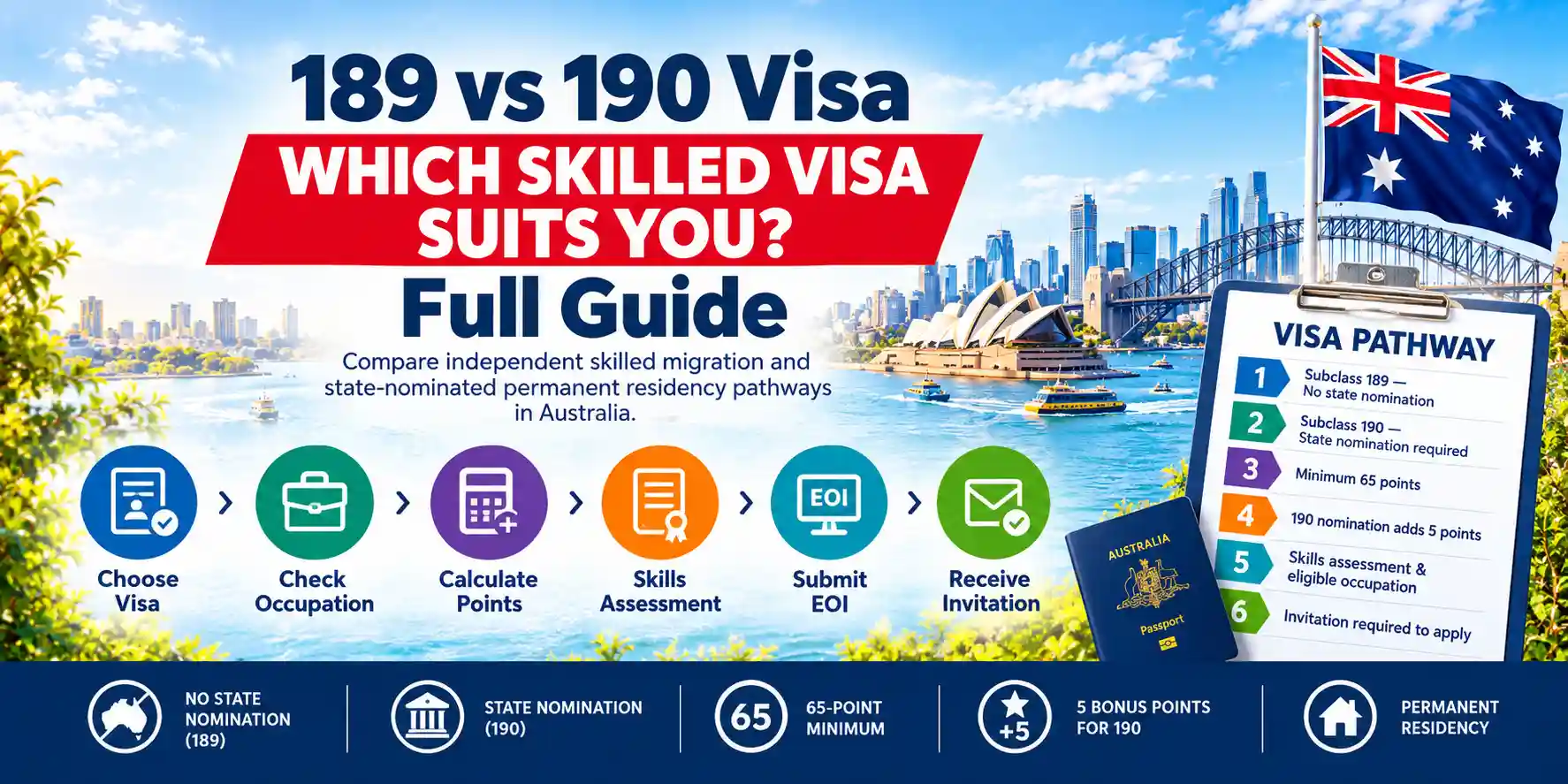
Australia has several skilled visa categories for people with the right skills and experience. The two most popular visas are Skilled Independent visa (subclass 189) and the Skilled Nominated visa (subclass 190). Both are permanent visas with slightly different emphases. The key differences are how you receive an invitation and whether a state or territory nominates you.
Choosing between the 189 and 190 visa depends on occupation, points, skills assessment, English skills and migration objectives. The subclass 190 is nominated by the state/territory government, whereas subclass 189 is not. Understanding these differences can help you decide which option suits you best.
What is the 189 Visa?
The Skilled Independent visa (subclass 189) is an invitation-only visa for skilled workers who meet the necessary requirements. It doesn't involve an employer, family member or a state or territory government to sponsor it. Once granted, it gives you a permanent visa allowing you to live and work in Australia anywhere. To apply through the points-tested stream, you submit an Expression of Interest (EOI) through SkillSelect. You need an eligible occupation, a suitable skills assessment and enough points to meet the points test. The visa application can only be submitted if the applicant is invited to do so.
Currently the minimum points are 65, with 65 points not being a guaranteed invitation. Occupation demand, the number of available places and competition in invitation rounds can mean a higher score is needed.
What Is the 190 Visa?
The Skilled Nominated visa (subclass 190) is also a permanent skilled visa. It is geared towards skilled workers who are nominated by a state or territory government in Australia. It's a points-tested visa that can only be applied for after an invitation is received, similar to the 189 visa.
State and territory governments nominate independently of each other, and each has its own requirements based on its workforce needs. These requirements can change and may include specific occupations, work experience, English ability, employment or other criteria. The primary benefit of the 190 visa type is that state nomination adds 5 points to your points test score. However, these points apply only once you have been nominated and invited for subclass 190 visa.
189 vs 190 Visa: Key Differences

The subclass 189 visa and subclass 190 visa are both points-based and can lead to permanent residency in Australia. Each one must fulfill the necessary points and eligibility criteria, but you receive an invitation to apply in different ways. A subclass 189 application does not need state or territory nomination, while a subclass 190 application must be endorsed by a state or territory. Depending on your occupation, points score and circumstances, this can affect your eligibility and invitation pathway.
|
Difference |
||
|
State nomination |
No state or territory nomination is required. |
State or territory nomination is required. |
|
Points requirement |
You need at least 65 points to meet the basic points threshold. However, 65 points does not guarantee an invitation. |
You also need at least 65 points, including 5 points for state or territory nomination. A higher score may be needed to receive an invitation. |
|
Invitation process |
You submit an EOI through SkillSelect and may receive an invitation based on your points, occupation and the relevant invitation arrangements. |
You generally need to meet a state or territory's nomination requirements before receiving an invitation to apply. |
|
Occupation requirements |
Your occupation must be eligible for the subclass 189 visa and meet the relevant skilled occupation requirements. |
Your occupation must be eligible for the subclass 190 visa and may also need to meet the requirements set by the nominating state or territory. |
|
Where you can live and work |
You can live and work anywhere in Australia after the visa is granted. |
You can also live and work in Australia, but you should consider the commitments you made when accepting state or territory nomination. Each state or territory may have its own nomination requirements or expectations. |
|
Flexibility |
Offers more flexibility because there is no state or territory nomination. |
Provides permanent residency but involves a state or territory nomination. |
|
Competition |
Invitation chances depend on your points, occupation and competition in the relevant invitation rounds. |
State nomination provides an additional pathway, but you still need to meet the state's requirements and compete for nomination. |
|
Skilled work experience |
May contribute points. |
May contribute points. |
Applicants who score a high number of points and are able to compete without state nomination could be considered for the 189 visa. Applicants who are eligible for state or territory nomination may also consider the 190 visa and use the additional 5 points to strengthen their score.
189 vs 190 Visa Eligibility Requirements
There are a number of similar requirements that need to be fulfilled in order to be eligible for both visa subclasses. You must have an eligible occupation, a suitable skills assessment, an invitation and a points score that meets the points test.
However, the 190 visas have one other significant requirement and that is state or territory nomination. This will involve applicants taking into account the criteria of the state or territory in which they wish to be nominated and their own experience.
- Age: You must be under 45 when invited. If you turn 45 after receiving the invitation, you can still apply. If you turn 45 after submitting the EOI but before invitation, you will not be invited.
- English language proficiency: Competent English is required at invitation on the points-tested pathways. You may also get extra points in the points test for higher levels of English.
- Skilled occupation: Your nominated occupation must be eligible for the visa you are applying for. When preparing an EOI, always be sure to refer to the relevant occupation list as some subclasses have different eligibility requirements for the occupation they are interested in.
- Skills assessment: It is generally necessary for your nominated occupation to have a suitable skills assessment. The assessment will need to be compliant with the visa pathway and occupation requirements. There will be a need to provide evidence to back up skills assessment along with any other claims that are offered within your EOI.
- Points score: Both visas require applicants to score points. You must score a minimum of 65 points to be eligible for invitation, but the higher the score, the greater the chance of being invited. Points can be earned for age, English ability, skilled employment, education and other factors.
- Work experience: You may earn points for experience in your skilled occupation, depending on the number of years worked and whether the experience was gained in Australia or overseas. Points can be awarded for overseas skilled employment (up to 15 points) and Australian skilled employment (up to 20 points) under the current points table. The experience must meet the relevant rules to be counted.
- State nomination for Subclass 190: The subclass 190 visa requires nomination by a state or territory. Every State and Territory has their own set of nomination criteria and may be looking for specific occupations, skills, experiences and more.
Before you submit an EOI or nomination application, you should see what requirements the state or territory have where you wish to be nominated.
189 vs 190 Visa Points Comparison
Points play a major role in the subclass 189 visa and 190 visa applications. Your points are based on factors such as your age, English skills, work experience and education. The general points test is the same for both visas, but the 190 visa offers an extra 5 points merit for state or territory nomination.
You can earn your points for the following:
- Age
- English language skills
- Skilled work experience
- Educational qualifications
- Australian study
- Specialist education
- Credentialled community language
- Study in regional Australia
- Professional Year in Australia
- Eligible partner skills
The number of points you can collect will depend on your particular situations and if they meet the criteria of each category.
- Minimum points for 189 and 190 visas: The 189 visa and 190 visa are both a 65 points minimum. In order to be invited, however, a higher score than 65 may be needed. It may be more difficult to get an invitation to score higher, depending on your profession, number of applicants and the number of places in an invitation round.
- 5 additional points for the 190 visa: One of the benefits of having a subclass 190 visa is that once you are nominated by a state or territory, you receive an additional 5 points on the points test. For example: If you have 70 points before nomination, the 190 nomination would raise your score to 75.
- Impact of the Additional 5 Points: The 5 extra points will give your profile a competitive edge, especially if you're on the razor-thin edge of being invited. The 190 visa also provides an additional visa stream for state or territory nomination.
There are requirements to meet the state/territory requirements, some of which may vary from state to territory; you must meet each state’s requirements, which vary, including occupation lists and nomination places.
189 vs 190 Visa Processing and Invitation

Both the subclass 189 and 190 visa processes start with an Expression of Interest (EOI) through SkillSelect. You provide details about your age, education, English skills, work experience, occupation and other relevant information. The biggest difference is that the 189 visa doesn't require state/territory nomination, but the 190 visa does.
Expression of Interest (EOI)
An EOI and an application for a visa are not the same. It is a statement that you wish to be taken into account for the Australian Government to consider you for a skilled visa. When applying for an EOI, you will include details of:
- Your age
- English language skills
- Qualifications
- Skilled work experience
- Occupation
- Points score
- Other relevant details
You then wait and see if you are invited.
189 Visa Invitation
If applying for subclass 189 visa:
- Submit an EOI through SkillSelect.
- Your EOI is considered in the relevant invitation rounds.
- When you are invited you may be able to lodge a visa application.
- You provide supporting documents when you lodge the visa application.
190 Visa Invitation
If you're applying for a subclass 190 visa:
- Submit an EOI through SkillSelect.
- Subclass 190 is a state/territory-nominated visa, and you must be nominated by an Australian state or territory government agency to be invited for the 190.
- Each state and/or territory assesses eligibility to become a nominee.
- If you are nominated and an invitation to apply for a visa is received you may lodge your visa application.
Documentation is required to substantiate EOI claims when you lodge the visa application, not as part of submitting the EOI itself.
Why invitation chances can vary
Both are points-tested visas. If invited, the invitation specifies the points score you must meet when the application is assessed, and it can be higher than 65. Chances of invitation are based on:
- Your total points
- Your nominated occupation
- The number of applicants expected
- Available places
- The 190 visa is subject to state/territory requirements.
- Current priorities and invitations for the government.
In the case of a high contest, for example, 65 is the minimum threshold for eligibility, but it may not be enough to receive an invitation.
Which Visa Is Better for You: 189 or 190?
No single visa suits everyone. This will vary depending on your occupation, points total achieved, and eligibility and if able to satisfy state/territory nomination criteria.
1. The 189 visa may suit you if:
If you possess a strong profile, then you may wish to apply for a subclass 189 visa without state or territory nomination. It can be flexible after a visa is granted as well.
- You have a competitive points score.
- You have an occupation that is an Eligible Occupation for the 189 visa.
- You would prefer a pathway that does not depend on state or territory nomination.
- You would like to be able to work and live anywhere in Australia on the granted visa.
2. The 190 visa may suit you if:
The 190 visa may suit you if you want to live and work in a particular state or territory and can use the extra 5 points from nomination to boost your score.
- You meet the relevant state or territory requirements.
- You have identified an occupation that qualifies for nomination.
- You can obtain a state or territory nomination.
- The additional 5 points would strengthen your points score.
- You are prepared to accept the state or territory’s nomination conditions.
Things to consider before choosing
When deciding between the 189 visa and the 190 visa, it's essential that you consider your application as a whole and not take into account only your points. Review your occupation, skills and experience, and ask whether you have a realistic chance of meeting the requirements for either pathway.
- Occupation: Is your occupation eligible?
- Points: How competitive is your current score?
- English: What level of English can you claim?
- Skills assessment: Do you meet the requirements for your occupation?
- Experience: How much relevant skilled work experience do you have?
- State nomination: Can you meet the requirements of a state or territory?
- Invitation chances: Which pathway is more realistic for your profile?
Considering these factors in combination can assist you in determining if the 189 or the 190 visa is a better visa path for your situation.
Conclusion
The subclass 189 and 190 visas are both permanent skilled visas, but they are applied for differently. The 189 visa doesn't require state nomination and is generally more flexible when compared to the 190 visa, and the 190 visa gives an additional 5 points. Meeting minimum 65 points is critical for both visas, but not enough to secure an invitation and should be taken into consideration with your occupation, points score and overall profile.
At Achievement Education and Visa Services, we can counsel individual applicants on available visa options and guide their application process based on those options. We can connect you with a trusted Nepali migration consultant in Sydney, and our MARA-associated team can support you with eligibility assessment, points calculation, state nomination guidance, documentation and the visa application process.
Recommended Blogs:
1. What is the Subclass 189 Visa? Cost and Grant Guide (2026)
2. Subclass 190 Visa Australia: State Nomination and PR Pathway
FAQs
1. Is 189 or 190 visa better?
Neither visa is inherently better to the other as it depends on your situation what type of visa will be suitable. The 189 visa might be appropriate for applicants with a strong and competitive profile and who are looking for an independent visa pathway, whilst the 190 visa might be appropriate for an applicant that is called for nomination by a state or territory.
2. What is the main difference between 189 and 190 visas?
The primary difference is that of state nomination. The 190 is the state/territory-nominated visa. The 189 does not require state or territory nomination. The 190 visa adds 5 points to your points test score, which the 189 visa does not.
3. Is 65 points enough for a 189 or 190 visa?
65 is the minimum points score. But not every application that gets 65 points gets invited – the competition and available places, along with the occupation, can increase the invitation scores for some applications.
4. Can I live anywhere in Australia on a 190 visa?
The subclass 190 visa is a permanent visa that allows you to live and work in Australia. It does not legally restrict you to the state or territory that nominated you. However, because you receive the visa through state or territory nomination, you should consider the commitments and expectations of the nominating state or territory.
5. Do I need a skills assessment for both 189 and 190?
Applicants for both visas generally need a suitable skills assessment for their nominated occupation as per the rules and exceptions for their nominated occupation.