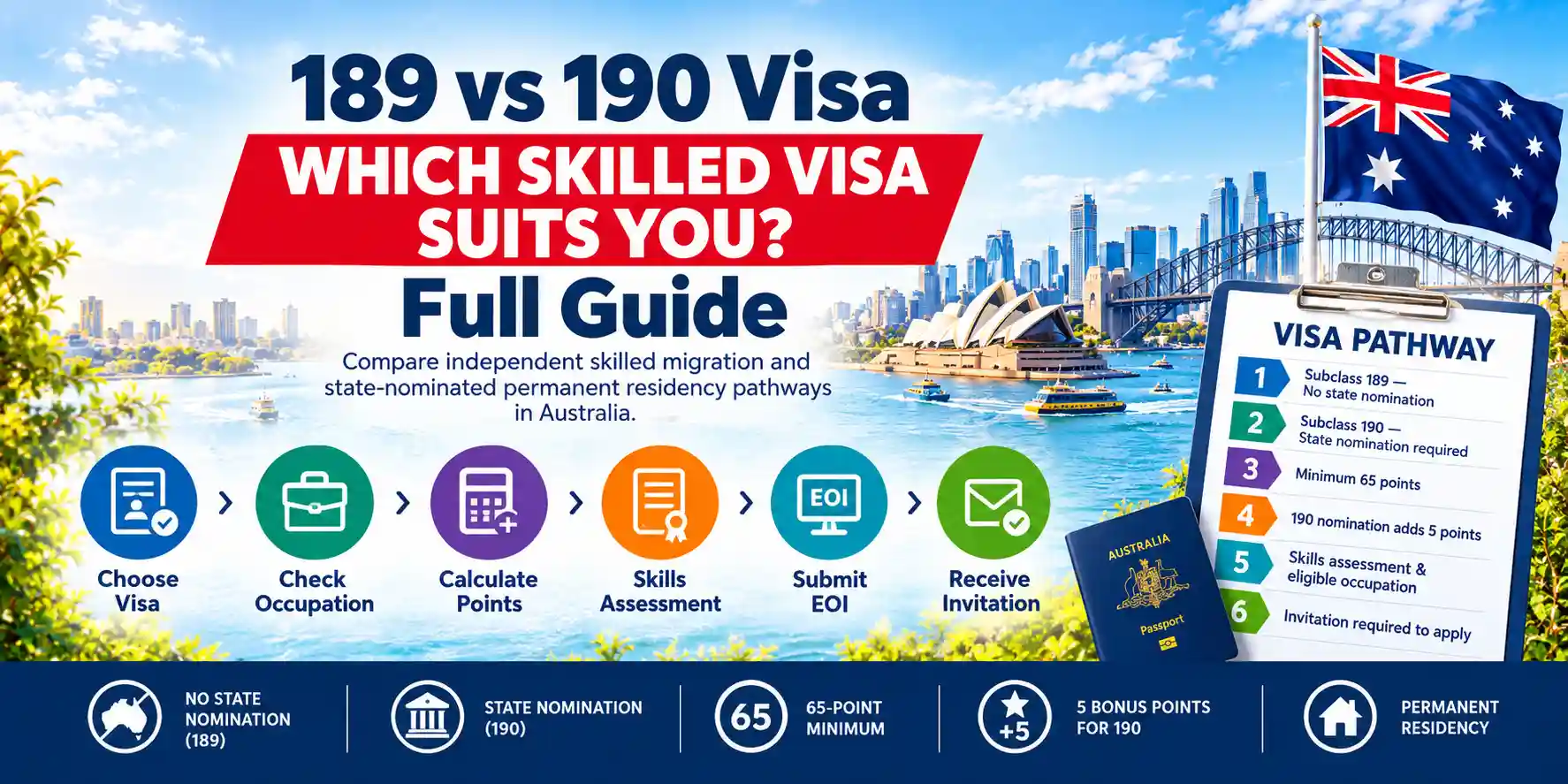

The Skilled Nominated visa (subclass 190) is a permanent visa for eligible skilled workers who want to live and work in Australia. The visa is different from the Subclass 189 visa as it involves a state nomination by one of the state and territory governments in Australia. In addition to meeting the conditions of the skilled points test, those who are nominated by the State can receive an additional five points on. However, there are different requirements for eligibility and occupation lists as well as the nomination process in each state and territory.
We cover the basic prerequisites and application procedure for the subclass 190 visa in this blog. You will get an understanding of the process of state or territory nomination, who is able to be considered for this visa, how the points system would apply, and what you will need to do prior to applying for this visa. If you are considering skilled migration, it's important to understand these steps to help you clarify if the Subclass 190 visa is the path for you or not.
What Is the Subclass 190 Visa?

This visa, also referred to as the Skilled Nominated visa, is a permanent visa for eligible skilled workers that wish to live and work in Australia. You will generally need to meet the skilled migration points test requirements, have an eligible skilled occupation, receive nomination from an Australian state or territory government, and receive an invitation to apply for the visa. An invitation to apply is required for you to make your visa application as well. Each state and territory has its own requirements and may select skilled migrants based on these requirements, as well as the skills and occupations needed in their respective areas.
Upon gaining the visa, you may live/Work in Australia as permanent Resident on the Subclass 190 visa. State or territory nomination is significant to this visa pathway in that applicants must satisfy both federal visa criteria and state/territory visa criteria. Requirements for nominations are subject to change so it is important to obtain the current information from the **Department of Home Affairs** and appropriate state or territory government before making a nomination.
How Does State Nomination Work for the Subclass 190 Visa?
State or territory nomination plays a significant role in the process of applying for the visa subclass 190. The states and territories of Australia can nominate a skilled worker who has skills and expertise that they are looking for in their territory or state, and whose skills and experience is required in the state and territory.
Typically, the procedure begins with an Expression of Interest (EOI) usually sent via SkillSelect. The state (or territory) of your interest for nomination will be shown. In addition, you may need to complete a Registration of Interest (ROI) and/or state nomination application, depending on the state or territory. If a state/territory chooses to include you in the state's nomination program, and nominates you, you will be awarded 5 more points towards the points test for the subclass 190 visa.
Several factors can influence a state's nomination requirements, such as:
- Your nominated occupation
- It requires skills, ability level and qualifications.
- Your work experience
- Your English language ability
- Whether you are living in Australia or overseas
- Current skills needs of the state/territory
- Any occupation-specific requirements
Meeting the minimum requirements does not guarantee nomination or an invitation for a nomination or an invitation to apply. State nomination programs are often competitive and there are only a specified number of nominations in each state and territory. Check the most current requirements for nomination prior to submitting your EOI or applying for state nomination.
Who Is Eligible for the Subclass 190 Visa?
These requirements generally include both Australian Government visa requirements and state or territory nomination requirements. Permission from the state/territory and an invitation to apply for the visa are also required.
Typically, applicants must have the following criteria:
- The required skills level for your nominated occupation
- Registration requirements for your nominated occupation
- A suitable skills assessment for your nominated occupation
- The required level of English
- The required points to meet the points test criteria
- Having been invited to apply, but failed to do so before turning 45 years of age
- Possession of a skilled occupation that is recognized in Australia as an eligible skilled occupation.
- Having a suitable skills assessment for the nominated occupation
- English language attainment (relevant to the qualifications being studied)
- Applicants must meet the minimum points requirement
- Being nominated by an Australian State or Territory Government
- Leading up to receiving invitation to apply for Subclass 190 visa
Specific requirements may differ depending on your profession and from the state or territory in which you want to be nominated. For example, the Subclass 190 visa requirements include age, skills assessment, occupation, points, and English language ability. Before you apply for this visa class, you should ensure you meet the Department of Home Affairs requirements and the current nomination requirements for the state or territory where you are seeking nomination.
How Many Points Do You Need for a Subclass 190 Visa?
The minimum skilled visa points required for the subclass 190 visa are typically between 65 points. Applicants can receive up to five additional points through state or territory nomination, which can help them reach the minimum required score of 65 points. Points may be awarded for factors such as:
- Age
- English language ability
- Skilled work experience
- Educational qualifications
- Australian study
- Specialist education qualifications
- Partner qualifications/other eligibility criteria
- Each state and territory has its own processes to nominate skilled workers.
However, achieving 65 points does not guarantee that you will receive an invitation to apply. Skilled migration and state nomination (SN) visa programs are liable to be competitive, and states may have their special-will prioritising rules, which state to favour applicants will also depend on their occupation, skills, experience and the requirements of the jobs they would take. Therefore, it is critical to ensure that all claims made in your submission for an EOI are factual and backed up by evidence.
How to Apply for the Subclass 190 Visa

The visa process for the subclass 190 visa includes a number of steps, such as determining eligibility and lodging an Expression of Interest (EOI). There are also state/territory nomination, and invitation to apply requirements that must be met before lodging a visa application. The exact process may differ from state to territory, but is broadly similar.
The visa application process for subclass 190 visa and what to do at each stage is explained below in a general way.
Step 1: Check Your Eligibility
To meet the basic requirements for the subclass 190 visa you need to determine if you qualify. You need to ensure that your occupation is eligible, obtain or check your skill assessment requirements, work out your points and ensure you have the relevant English language requirements. The requirements of the State or Territory you wish to make an application for nomination in should also be checked. The lists and criteria of occupations may differ by state and territory.
Step 2: Submit an Expression of Interest (EOI)
After meeting the requirements, the next step is to normally follow the processes of submitting an Expression of Interest via SkillSelect. This EOI gives details of your abilities, qualifications, work experience, English language proficiency and other relevant information for the skilled migration points test. An EOI may not be a visa application. It is a gesture of being interested in being considered for a skilled migration visa.
It is important to ensure information in your EOI is correct as you could be required to provide supporting evidence for the statement(s) you make should you get an invitation.
Step 3: Apply for State Nomination
The requirements vary by state or territory in which you are applying for nomination. There may be a second Registration of Interest (ROI) required for many states and/or other forms of nomination procedures may apply. You might be asked for more information about your job, qualifications, work or link with the state. For instance, in Victoria, all individuals wishing to become eligible for nomination must first register for the visa by applying for an EOI via SkillSelect and then after, a Registration of Interest to be nominated as a skilful visa in Victoria. Please note that the requirements will differ from time to time and from state to state so always ask the government in the territory or state you choose to apply in.
Step 4: Receive an Invitation to Apply
You could be invited to apply for the Subclass 190 visa if you are nominated and your expression of interest will be accepted by your state. Despite being invited it is still important to ensure that all visa requirements are fulfilled and that the necessary supporting documents are turned in when your visa is submitted. All of the information submitted should substantiate what you represent in your EOI.
Step 5: Lodge Your Visa Application
Once you have been given an invitation to apply for subclass 190 visa you are able to submit your application to the Department of Home Affairs. Documents to back up your application will be required. These could be about who you are, your skills assessment, English language skills, your qualifications, your work history and more depending on your situation.
Your visa application will then be examined by the Department of Home Affairs. A visa nomination from the state doesn't guarantee a visa will be awarded; visa applicants will still need to comply with all the requirements for a visa.
What Are the State Nomination Requirements?
There are varying state requirements for being nominated. Each state and territory have their own prescribed set of nomination requirements. The requirements stipulated by the Department of Home Affairs for a subclass 190 visa are normally required to be met prior to application. Applicants must also meet any eligibility requirements set by the state or territory they are applying.
Requirements (may vary state/territory):
- An occupation on the appropriate skilled occupation list
- Meeting occupation-specific requirements
- Having a certain level of work experience
- Meeting English language requirements
- Living and working in the relevant state or territory
- Having to comply with specific requirements for offshore applicants
- Submitting an ROI or separate nomination application
- Showing a commitment to living and working in the nominating state
For example, the Department of Home Affairs criteria must be met in addition to the requirements of South Australia, such as specific occupation, and stream requirements. Specific requirements may also be different from year to year. Applicants are advised that they must always compare the most current data provided by the state or territory government ensuring that the information they apply with is the most up to date.
What Can You Do With a Subclass 190 Visa?
The subclass 190 visa is a permanent visa that enables holders to live and work in Australia permanently if they have the right skills and qualifications. Upon receipt of the visa several rights and benefits are provided, some of which are contingent on your eligibility, such as access to Medicare.
As a subclass 190 visa holder you'll normally be able to:
- Live in Australia permanently
- Work in Australia
- Study in Australia
- Access Medicare, if eligible
- Help eligible family members to come to Australia by sponsoring them.
- Travel to and from Australia during the visa's travel facility
- If you are eligible you can apply for Australian citizenship
The visa is state/territorial nominated, so there is an expectation that you will intend to live and work within that state/territory. Individual states can also have specific commitments following the nomination. For instance, South Australian nomination conditions are that you must intend to live and work in South Australia for a minimum of two years after the visa is issued.
Subclass 190 Visa vs Subclass 189 Visa: What Is the Difference?
Both the 190 visa and the 189 visa are a category of visas designated as skilled visas which qualifies the visa holder for permanent visa in Australia. It is only in the way the applicants are nominated and how an applicant may pass the skilled migration points test, that they differ significantly. The following are the main differences:
|
Feature |
Subclass 190 Visa |
Subclass 189 Visa |
|
Visa type |
Permanent visa |
Permanent visa |
|
State or territory nomination |
Required |
Not required |
|
Nomination points |
5 additional points |
No state or territory nomination points |
|
State or territory connection |
Nominated by a state or territory |
No state or territory nomination required |
|
Skilled migration pathway |
State or territory nominated |
Independent |
Conclusion
The Subclass 190 visa is a permanent skilled visa for eligible applicants who have been nominated by an Australian state or territory. Applicants generally need to meet the visa requirements, achieve the required points score and receive state or territory nomination before being invited to apply. As nomination criteria vary between jurisdictions, it is important to check the latest requirements and understand the process before applying.
For guidance on skilled migration pathways, Achievement Education and Visa Services, recognised by many clients as the Best Student Visa & Migration Consultant in Sydney, can help you understand your available options. We provide personalised guidance based on your circumstances, explain relevant visa conditions, documents and requirements, and support you throughout the application process. Our migration assistance is provided by appropriately registered migration professionals.
FAQs on Subclass 190 Visa Australia
1. Is the Subclass 190 visa a permanent residency visa?
Yes, the subclass 190 visa is a permanent visa. Successful Visa holders will be allowed to reside and work in Australia indefinitely. With that being said, there are visa requirements candidates must meet and they must be nominated by the Australian state/territory.
2. How many points do I need for a Subclass 190 visa?
The 65 skill points requirement for applicants in general is a combination of their performance in the skilled migration points test and 5 points that can be gained through state/territory nomination. Meeting the minimum points criterion is no guarantee of an invitation, however. Some State nomination systems will be competitive and may take other factors into account in selecting applicants.
3. Does the Subclass 190 visa require state nomination?
Yes, visa subclass 190 itinerant requires a State or Territory nomination. Must satisfy the nomination criteria of the state/territory and visa criteria of the Australian Government. Every state and territory has unique rules and requirements for occupations.
4. Can I apply for a Subclass 190 visa from outside Australia?
It is possible to apply for this visa from overseas, provided you are eligible for visa and state nomination.Nominating pathways for offshore skilled occupations exist in some States and Territories. Your options will vary and cover available pathways based on your occupation and the current needs of relevant state/territory.